DigiGauss DG3
Quick Break TESTER
Quick Break Tester / Magnetometer
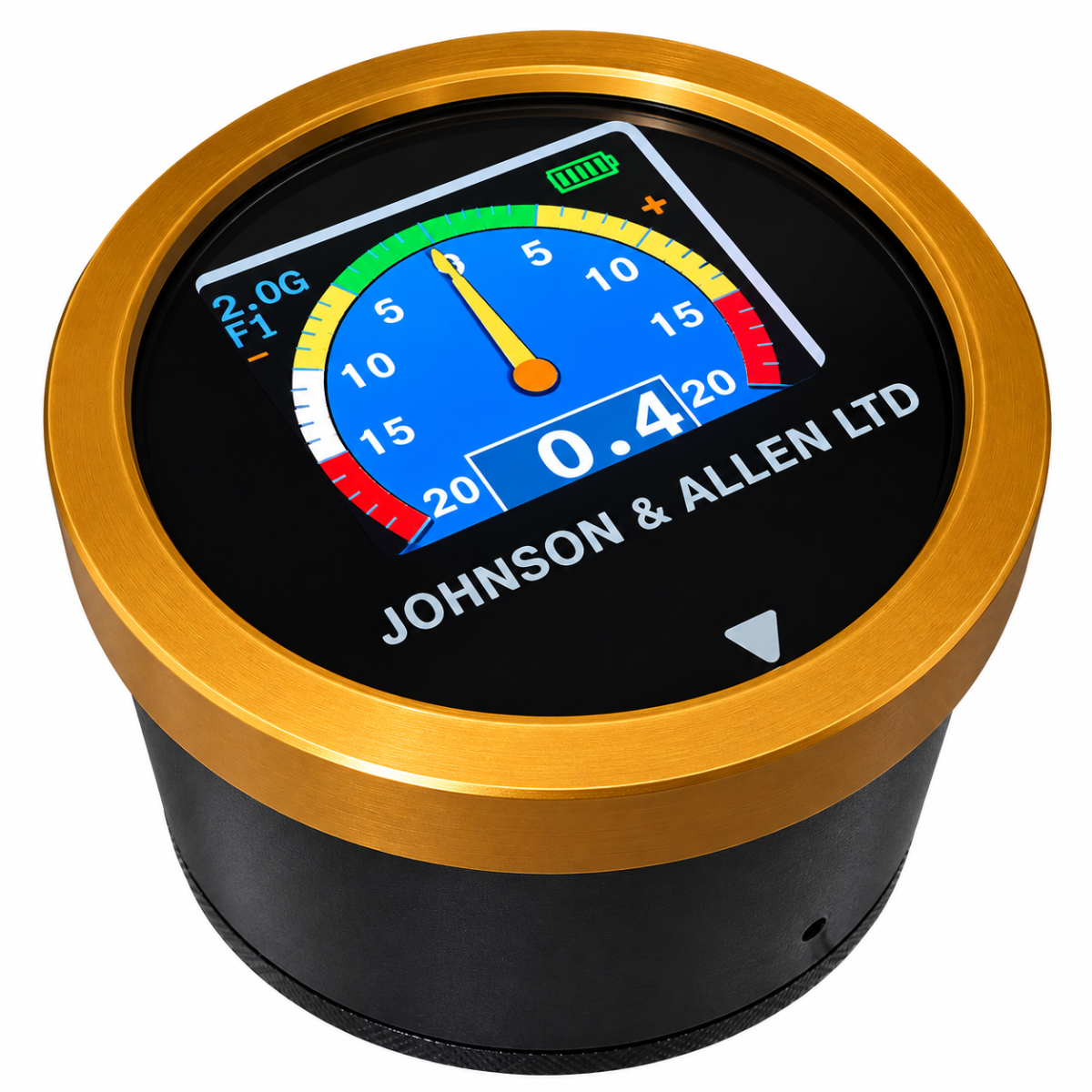
The DigiGauss DG3 is the multi-purpose upgrade to the DigiGauss DG1 digital magnetometer field indicator used for measuring the level of residual magnetism in ferromagnetic material.
In addition to the magnetometer functionality found in the base DigiGauss DG1 model, the DigiGauss DG3 includes advanced features for use in NDT including the Quick Break Tester / Analyser mode.
As well as other useful features like a Mag Timer for measuring mag "shot" duration and Mag Scopes for displaying waveforms with an inbuilt miniature precision oscilloscope.
The DigiGauss DG3 represents the next generation of Quick Break Testers.
What is a "Quick Break"?
Quick Break is the ability of MPI equipment to abruptly break the current flowing through a coil which causes the magnetic field to quickly collapse. This is practically achieved using high speed switches / contactors.
The reason it is important to obtain a Quick Break is that a slow collapse of the field will reduce the residual magnetisation in the component and allow the magnetic poles to migrate. As a result the flux lines at the ends of the part can become normal to the surface rather than tangential and MPI indications will not show up clearly and reliably.
While the field is collapsing a spike of Voltage is created within the component proportional to the rate of change. If the rate is fast enough, then the magnitude of that spike will be large and the entire mass of the part is needed to dissipate the resulting energy. This forces the magnetic flux out to its maximum extent. The previously common accepted method for measuring Quick Break was to measure the Voltage of the induced spike at the end of the shot.
Quick Break is only applicable with 3 Phase FWDC currents because the Quick Break needs to interrupt a continuously flowing current to cause a back EMF. This would not be possible on single phase AC, HWDC or FWDC currents.
Quick Break and Faraday’s Law
Up to now there has not been a simple method of detecting the rate of change of a collapsing magnetic field and so the standard method was to detect a back EMF voltage in a detect coil and empirically equate that Voltage to the coil diameter size alongside the rate of change of magnetic flux.
Such that if there was sufficient collapsing field, within a sufficiently short space of time (i.e. a fast collapse), a sufficiently induced EMF would be seen in a detector coil - Which would be proportional to the original magnetic field strength and its speed of collapse.
The faster the rate of change of the magnetic field collapsing and the greater the rate of change of magnetic field amplitude (from the maximum to minimum levels) the more effective the Quick Break.
DigiGauss DG3’s measurement of Quick Break
Because the DigiGauss DG3 can detect the actual magnetic field it can calculate the speed of the rate of collapse of the magnetic field directly.
And it is better to measure the magnetic field directly as calculating the induced Voltage as an intermediate step brings in other variables. These factors include the coil size, number of turns, impedance and speed of transient response of the Voltage measurement and Induction of EMF from other parts of the machine - All of which could introduce other errors.
Historically it has not been possible to measure the field directly - As such the DigiGauss DG3 represents the future of Quick Break analysis methodology.
Quick Break Timing
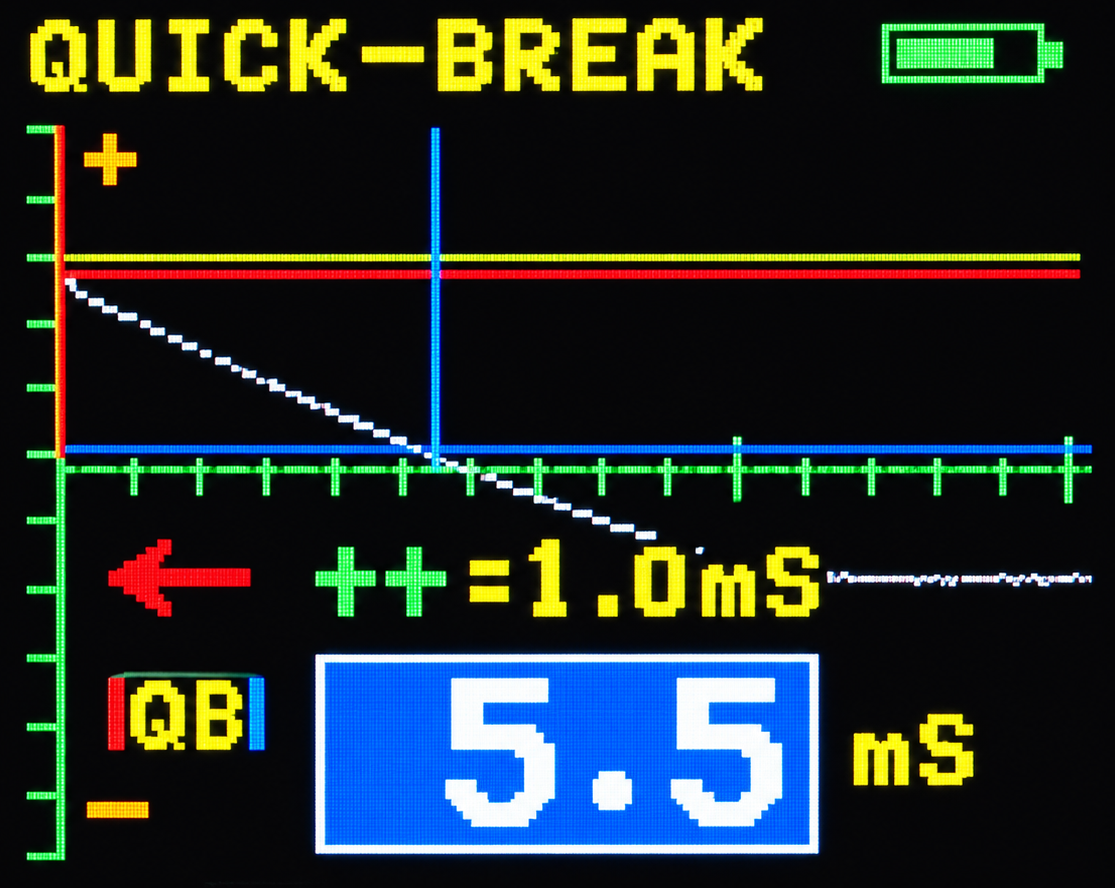
With the DigiGauss DG3 in Quick Break mode and positioned inside a coil the DigiGauss DG3 will wait to detect a Quick Break magnetic pulse and automatically calculate the Quick Break time and display a waveform trace of the collapse.
What is an acceptable Quick Break?
ASTM 1444-26 states that equipment with a Quick Break feature must have that function verified and the check may be performed using a suitable oscilloscope or another applicable method specified by the equipment manufacturer. The check must be performed at least once every 6 months or at a frequency dictated by the quality system being adhered to.
ASTM 1444-26 (Standard Practice for Magnetic Particle Testing for Aerospace) does not state a specific universal Quick Break time.
As such users should consult the OEM of the MPI equipment for this information - Johnson & Allen can provide this information for Johnson & Allen FWDC (3Ph) MBU and LBU Bench Units and K9 Power Pack models on request.
Some organisations have their own internal Inspection standards - A number of aerospace primes for example have adopted their own Quick Break acceptance criteria, so it is strongly advised to check the standards being used before Inspection and Quick Break verification.
Miniature Precision Oscilloscope
The DigiGauss DG3 includes Mag Scope 1 and Mag Scope 2 modes which act as a miniature precision oscilloscope where the magnetic waveform is automatically detected and cycles of that waveform are displayed on the DigiGauss DG3 display.
Mag Scope 1 and Mag Scope 2 can display AC, HWDC and FWDC waveforms where:
- Mag Scope 1 will display a single cycle on the display
- Mag Scope 2 will display 4 cycles on the display
Mag Scope 1 and Mag Scope 2 are configured to sample 50Hz and 60Hz signals by default.
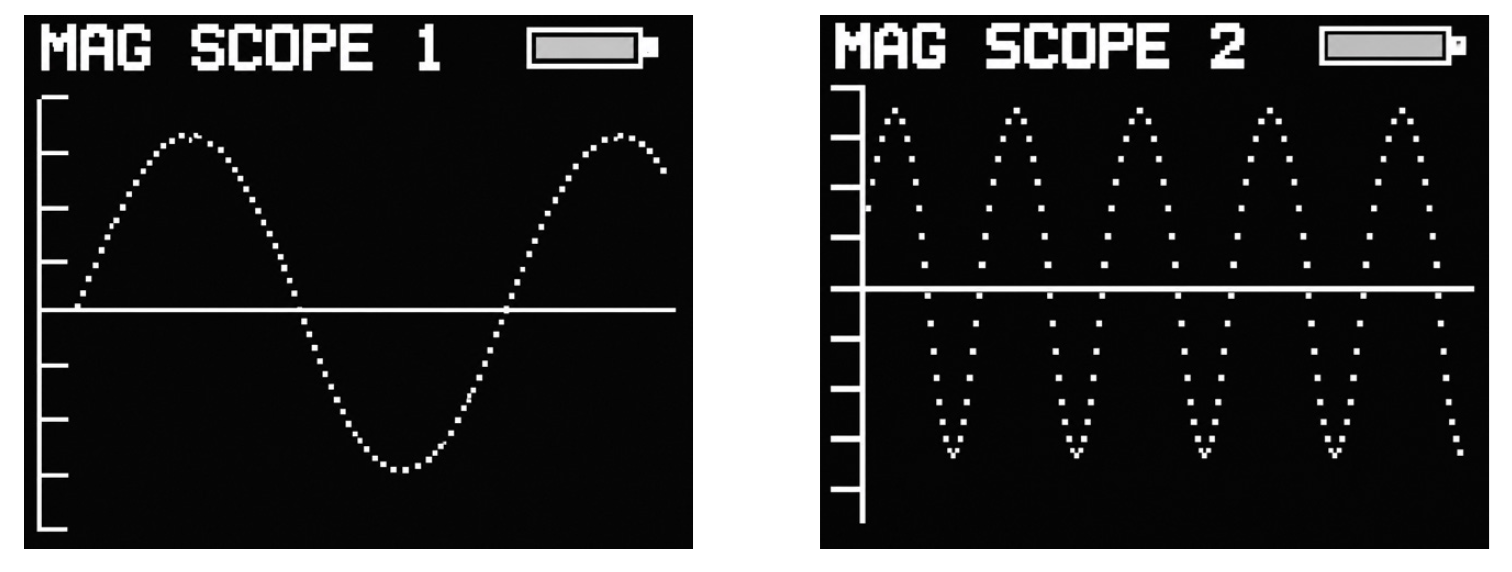 To achieve the clearest image the DigiGauss DG3 uses an Automatic Gain Control (AGC) feature. Meaning the amplitude of the displayed waveform will not be proportional to the magnetic field strength as the DigiGauss DG3 will automatically adjust the image to fit the waveform within the display.
Mag Scope 1 and Mag Scope 2 can be used as both a teaching aid to explain the types of waveforms used in MPI and to validate an MPI process by displaying waveform of the magnetic field (and hence the type of current flowing through the part).
Display Modes
| Magnetometer | ±20 Gauss deflection needle display with a black background which mimics older analogue devices. |
| Quick Scan 1 (±2G Trip) | Deflection needle display with blue background which becomes red when Gauss level exceeds a ±2 Gauss trip. |
| Quick Scan 2 (±5G Trip) | Deflection needle display with blue background which becomes red when Gauss level exceeds a ±5 Gauss trip. |
| Quick Scan 3 (±3G Trip) | Deflection needle display with blue background which becomes red when Gauss level exceeds a pre-programmed level - Default ±3 Gauss trip. |
| Large Digital Display | ±20 Gauss display with the measurement displayed in large numbers. |
| Battery Level Indicator | Shows the remaining battery level. |
| Mag Timer | Measure the length of a magnetic shot. |
| Mag Scope 1 | Miniature precision oscilloscope - Display 1 waveform cycle. |
| Mag Scope 2 | Miniature precision oscilloscope - Display 4 waveform cycles. |
| Quick Break [QB Timer] | Verify Quick Break on 3 Phase FWDC bench units and power packs by timing the collapse of the magnetic field. |
What is included?
| DigiGauss DG3 | 1 OFF |
| 1.5V AAA Battery | 2 OFF |
| Zero Gauss Chamber | 1 OFF |
| Operator Manual (ENGLISH) | 1 OFF |
| Calibration Certificate (ENGLISH) | 1 OFF |
| Plastic Carry Case | 1 OFF |
Technical Specification
| Display Resolution | Full colour 160 x 128 OLED display |
| Sensors | 4 x Hall Effect Cells |
| Construction | Aluminium Housing |
| Dimensions | 65mm Diameter x 37mm |
| Weight | 150 g |
| Calibrated Range | ±20 Gauss DC (Standard) |
| Calibration Type | 20-0-20 (Standard) |
| Resolution | 0.1 Gauss Increments |
| Sampling Frequency | 30.5 Hz |
| Sampling Range | 20 kHz |
| Battery | 2 x 1.5V AAA Batteries |
| Battery Life | 10 Hours (Typical) |
| Ingress Protection | IP54 |
| Storage Temperature | 5 to 20°C (Recommended) |
| Operating Temperature | 0 to 30°C |
| Warranty | 12 months |
| Origin of Manufacture | UK |
| Conformity | UKCA CE RoHS |
Share This Product